Eight Values of Free Expression


        The eight values of free expression are marketplace of ideas which is the idea that when truth and false can freely fight in the market truth will win. The second is participation in self-government which is that if free speech is vital for people to make informed and wise decisions for voting. Third is stable change which is the idea that when angry citizens can freely express their beliefs violence is less likely to occur. The fourth is individual self-fulfillment which is the idea that when individuals can express themselves freely, they can live their lives the way they want to. The fifth is check on governmental power which is that when people can call the government out, they are less likely to wrongdoings. The sixth is promote tolerance this means that through free speech a more tolerant society is better. The seventh is promote innovation which is when a society can freely express themselves their creativity and innovation is better. The eighth and final is protecting dissent meaning people that disagree with the majority are protected. These beliefs are all necessary and apply today the two I will specifically focus on are participation in self-government and check on governmental power. 

        Participation in self-government applies today as this is still the backbone of our election system. In recent presidential elections turmoil between the two major parties have been extremely high.  Due to this turmoil participation has never been more vital as the democratic and republican parties grow further apart, for American’s to be pleased with the results more people need to participate. This is also important as it keeps the government in check and allows the people to keep their rights without them being affected. Another reason why this is till important is that it causes the American government change to what the citizens want and not what the people elected to power do. 


        Another value that still applies today is that of check on government power. The idea of checks on government power is still extremely important in today’s world to protect the democratic system that America set in place. By having three branches of government two of which are elected by the people can check each other limits the harm that one branch can do. This keeps individual branches from becoming too powerful over the others This value is still extremely important as it helps the government work together to help the people living within the country and gives the people a way to stop the government from passing unwanted or harmful laws or bills. It also allows the elections hold more weight as even if people disagree with the president, they may still have Congress. 


        Overall, while all the values are still vital in today’s day and age. As they aim to protect and ensure that the citizens first amendment right of free speech is being protected and not infringed upon. In my opinion the two mentioned in detail above those being, participation in self-government, and check on governmental powers are the two most important for citizens in the current political climate in the United States. 

EOTO 2 Reaction: Facial Recognition Software


        I really enjoyed the presentation on Facial Recognition Software because it opened my eyes to how often I actually use this technology. As an avid user, I realized I should know more about its history.

        I was surprised to learn that the technology dates back to the 1960s. Although early attempts were ineffective, they marked the start of mapping facial features and exploring camera and processing capabilities. It's crazy to think that this technology, which I now use to unlock my phone, began all the way back in the '60s!

        Today, facial recognition has evolved significantly. Thanks to better cameras, faster processors, and machine learning, it's more reliable than ever. It's used in more places than I imagined like airports, law enforcement, and even retail stores.

        What really intrigued me during the presentation was how facial recognition actually learns your face. The software detects your face and creates a “faceprint,” which is like a fingerprint but based on unique facial features. This faceprint is then compared to others in databases to grant or deny access. For me, it's used to unlock my phone, which makes me feel secure knowing no one can replicate my faceprint. The presentation even mentioned that Apple claims there’s a one in a million chance of someone being able to use your faceprint.

        While I appreciate how secure and convenient this software is, it also raised concerns about privacy. As facial recognition data becomes more widespread, the question arises: Who has access to it?

        Overall, the presentation made me think more about the technology I use every day. It gave me a deeper appreciation for how secure facial recognition is, but it also made me realize the importance of privacy and security. It definitely encouraged me to do more research on these concerns as I continue using the software.

EOTO 1- The Invention of Paper:


        Paper was invented around two thousand years ago in Lei-Yang, China by a court official named Ts'ai Lung who wanted to make keeping track of his writings easier. Before paper people used items like animal skin or bamboo slips, these worked but were unpractical as they were expensive and hard to acquire. Ts'ai Lung came up with the idea to mash old rags, mulberry bark, and hemp together to create what is now paper.

    To make paper they would mash all of those ingredients and press them firmly together until all the liquid was gone, set them in the sun, and when they were dry they had paper. This new invention was cheaper, lighter, easily accessible, and the ingredients were available. The invention of paper made its way across Asia, and eventually everywhere else, which changed the way humans recorded history and shared information completely. 


    There are many benefits of paper. Starting off with easy knowledge sharing, one paper became more common it became easier to write things down. This led to books becomi
ng m
ore affordable which they could use in schools for lessons and textbooks, so education was more available. Continuing with knowledge sharing, many scientific discoveries and other ideas were shared because paper gave them the opportunity to spread these findings around the world. Another reason is better communication. With letters, newspapers, and official documents becoming easier to produce and handle. Paper provided an easier way to write and send messages. This helped build governments, businesses, and even friendships. One more reason paper was beneficial is creativity. Paper gave way for people to spark creative ideas. Art, books, and designers, all rely on paper to begin and share their work. These creative ideas would not have been able to spread without paper. 

    While there are many beneficial parts of paper there is still negative impact. Starting with environmental damage, paper comes from trees and even though recycling is an option, there are many people who do not recycle. Lots of forests must be cut down to acquire the materials needed to create paper, since we have become so reliant on it. This deforestation harms wildlife, increases carbon emissions, and messes with the climate. Another harmful impact of paper is waste problems. There are many pieces of paper in everyday life that just get tossed into a trash can instead of recycled. Receipts, flyers, packaging products all get thrown out frequently. 

    Paper is worth the negative impacts because it offers us so much, like education, information spreading, packaging products, cleaning products, and more. All these things are worth the negatives because it helps us complete everyday life.


Censorship on Anti War Views:

       
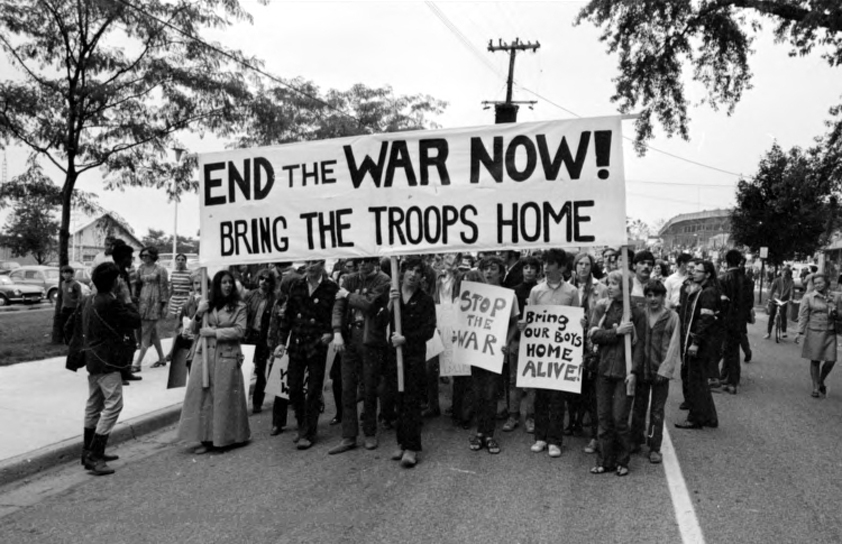
    There are many reasons why antiwar voices and views are rarely if ever heard on mainstream media. Antiwar voices have always existed in the United States, a major example of this was during the Vietnam War in which there was a massive uprising among college students protesting the war. Since this major event caused distrust between the government and the younger generation, the government now does its best to keep these voices out of the mainstream.  

A major part of this is that the media has corporate interests so networks such as Fox, CNN, NBC and others don’t want to paint a narrative and give voice to these antiwar views as it can harm their brand. They need to sell ad time and have sponsors, and both of those things could quickly become hard to do if they started to alienate their viewers and the CEOs and people in charge of other major businesses. These billion-dollar companies do their best to maintain that value, and to appeal to the people in charge rather than these smaller groups. These companies can also have a form of censorship for smaller ones to drown out the news and opinions they’re posting.   

Another reason is these media sources don’t wish to villainize the United States. In the recent wars the USA has been a part of, such as the wars in the middle east, to many Americans the USA was already on thin ice in terms of public opinion. If the media were to push out strong voices that spoke out against the country it would generate divide within the nation and could cause tensions to boil over between the United States government and the people. Instead, the media would want to focus on what these other countries are doing wrong and focus on the idea of supporting the troops no matter what. 


 Another reason is that the news sources don’t want to upset the government. As many of the sources the major news networks use are government officials, speaking out against what they’re doing could cause them to lose sources and in turn money. These rich owners and shareholders also don’t want to create enemies within all parties in government by speaking out against them. The strong nationalism and patriotism also cause antiwar voices to be covered. As the government and media want to unite the people to back and cheer for the United States in these wars. Patriotism has been around since the United States conception and it’s within the best interests of the people with power to keep it that way.  

These are all reasons I believe people rarely see and hear antiwar news and voices. These voices are forced to use independent and smaller outlets and blogs to post their opinion. These voices can now be hard to find, and often many people will have never heard them. This can harm the country however, as it drowns out voices wanting to be heard and makes it so less people know and could even join in and try to get antiwar voices into the limelight. Fortunately, these voices are still out there and able to be found and heard. It just takes more effort and time to find them, and there are less out there than the mainstream ideas and views. 


EOTO 2- The Human Capital Theory:

     Human Capital Theory is the idea that the more you invest in people, through their education, training, and health, the more productive they will become. In other words, it is saying people can be seen as a kind of capital, and as you upgrade them, they generate more value, just like machines and technology.  


Human Capital Theory    The appeal of Human Capital Theory is it gives a strong reason to invest in education and skill-building. If the government views their citizens as human capital, it will be more willing to fund public schooling, health services, and vocational training. For individuals, it is a way to understand how studying harder and learning basic skills would lead to better job opportunities and higher pay. To sum this up, the idea that if you invest and work hard on yourself, your reward will be bigger, which is motivating to humans. 

    While Human Capital Theory seems appealing, there are some flaws. One being that it tends to oversimplify things, it treats people like machines, saying if you put in a certain amount of everything you will get a certain amount of productivity back. But not everyone is the same, some people do not get the same return from their "investment". For example, many people go to college, work hard, and
invest heavily into their future. Sometimes it is still a struggle to find a job, especially if they are from a marginalized background. This theory does not consider racism, sexism, or class barriers. It assumes the playing field is level for everyone, which is not the case. Also, by framing education and skills solely in the terms of economic output, it ignores the deeper purpose of learning. Not everything should be based off productivity, some people
choose to study art, history, or philosophy, not to gain something but to understand the world better for themselves. Human Capital Theory is broad and does not take into account the personal interests of the people.


    Next, Human Capital Theory is very impactful to society. To start, the idea of work hard on yourself get a bigger, better reward, leads people to blame themselves or other people for being unsuccessful. Blaming others for their economic struggles, like if someone is unemployed or underpaid. This theory would suggest that those people did not invest in themselves enough. But it tends to forget that some people may not be able to afford schooling, or were busy raising a family, or were just living in a place with no good job opportunities. It also reinforces a very narrow view of human worth, where people only have value if they are economically productive, which tends to draw negative light to elderly people and stay-at-home parents who don't fit the productivity guidelines. Different segments of society tend to feel differently about this. Wealthier people tend to have more access to education and healthcare, so they see the benefits of this theory more easily. On the other-hand people from poor or marginalized communities are more likely to face barriers, so they tend to get left behind, even if they work twice as hard.  

    On a personal level, Human Capital Theory is inspiring but also stressful. It shows that I have the power to improve my future by continuing my education and developing skills. But it also brings the idea that I could never do enough to be on top, that I would constantly have to upgrade myself to be able to keep up with others.